
Home
For contractors
About us
Contact
Request a quote
Roof lanterns
Inspiration
Google-rating: 5.0★★★★★from 2 reviews
The U-value of glass shows how much heat passes through each square metre of glass for every degree of temperature difference between inside and outside.
A free, no-obligation quote tailored to you in just a few clicks. You finish on the quote page, where everything is already filled in.
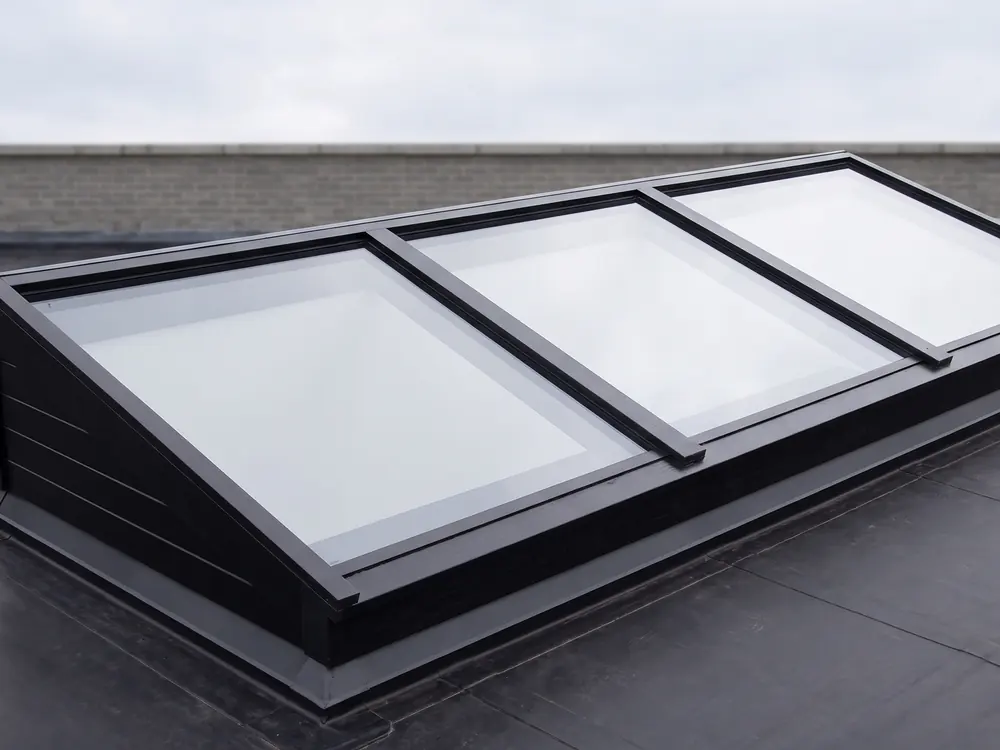
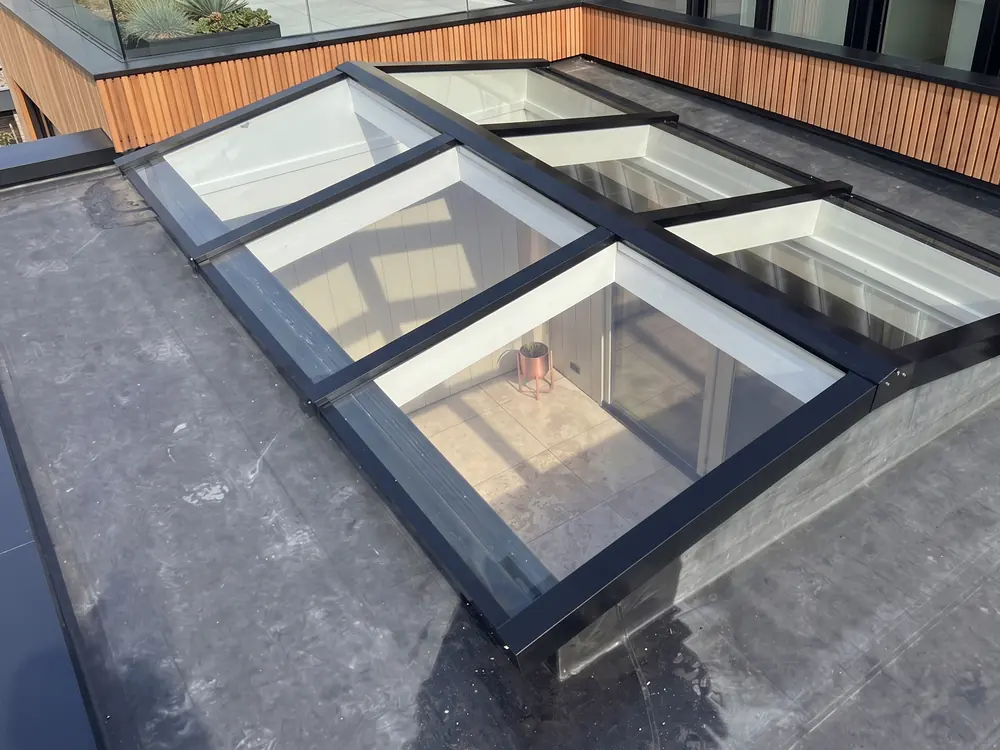 Lean-toGable
The U-value of glass shows how much heat passes through each square metre of glass for every degree of temperature difference between inside and outside. The lower the U-value, the better the glass insulates. HR++ glass is around 1.1 W/m²K, triple glazing around 0.5 W/m²K.
The U-value is expressed in W/m²K: watts per square metre per kelvin. A temperature difference of one kelvin is the same as one degree Celsius. A U-value of 1.1 therefore means that with one degree of difference, 1.1 watts of heat per square metre escape through the glass.
The figure says nothing about light or sun, only about heat loss through conduction, radiation and air movement in the cavity. For solar heat coming in, you use a different value, the solar factor. That plays a role with solar control glass.
Take a roof lantern with 4 m² of glass. It is a cold evening: 20 degrees inside, 0 degrees outside. The difference is therefore 20 degrees. The heat loss is the U-value times the area times the temperature difference.
With HR++ glass, that is 1.1 x 4 x 20 = 88 watts. With triple glazing, it is 0.5 x 4 x 20 = 40 watts. With older double glazing it would be 2.8 x 4 x 20 = 224 watts, and with single glazing as much as 464 watts. Your heating has to make up that heat continuously for as long as it is cold outside.
Over a whole heating season, that adds up. The article triple glazing or HR++ glass explains what the difference between the two means in gas in practice.
When comparing, check which U-value is being quoted. The Ug-value covers the glass alone. The Uf-value covers the frame, and the Uw-value the window and frame together. A well-insulating glazing unit in a poorly insulated frame delivers less than you might think. That is why our aluminium frames are thermally broken. More on frame materials under aluminium, timber or steel.
Glass in a roof lies flat or at a low pitch. In that position, the same unit insulates slightly less well than vertically in a wall, because the gas in the cavity moves differently. A stated U-value is therefore a good basis for comparison, not an exact prediction for every situation.
A low U-value does more than save energy. The inner pane stays warmer, so you feel less cold draught and condensation on the inside forms less easily. Under a roof lantern you notice that straight away, because cold air sinks down from the glass.
A low U-value is better. The lower the figure, the less heat escapes through the glass. Triple glazing at about 0.5 therefore insulates better than HR++ at about 1.1.
HR++ glass with a U-value of about 1.1 W/m²K is more than enough for most living rooms and kitchens. Above bedrooms or facing north, triple glazing at about 0.5 can be the better choice.
The Ug-value covers only the glass. The Uw-value covers the whole window, so glass and frame together. When comparing quotes, it helps to know which of the two is being quoted.
Send a photo or sketch with dimensions. Within 24 hours you receive a quote with glazing options, lead time and price.
Request a quote Get in touchA few questions, a photo or the dimensions, and we will prepare a tailored quote. Prefer to call: +31 342 223 190.
Request a quote More information