
Home
For contractors
About us
Contact
Request a quote
Roof lanterns
Inspiration
Google-rating: 5.0★★★★★from 2 reviews
Yes, a roof lantern and solar panels work well together on one flat roof, as long as you plan them together from the start.
A free, no-obligation quote tailored to you in just a few clicks. You finish on the quote page, where everything is already filled in.
 Lean-toGable
Yes, a roof lantern and solar panels work well together on one flat roof, as long as you plan them together from the start. Keep enough distance so the panels do not shade the glass and the lantern does not shade the panels. Also have someone check whether the roof can take the extra load of panels and ballast.
Combining a roof lantern and solar panels works well, but both need sun and space on the same roof. One brings daylight inside, the other turns sunlight into electricity. Plan them separately and you risk panels later shading the glass, or having no room left to clean the lantern.
So start with the position of the roof lantern, because it is tied to the room below. A roof lantern above the kitchen or dining table is often already fixed. You then fit the panels on the remaining roof area.
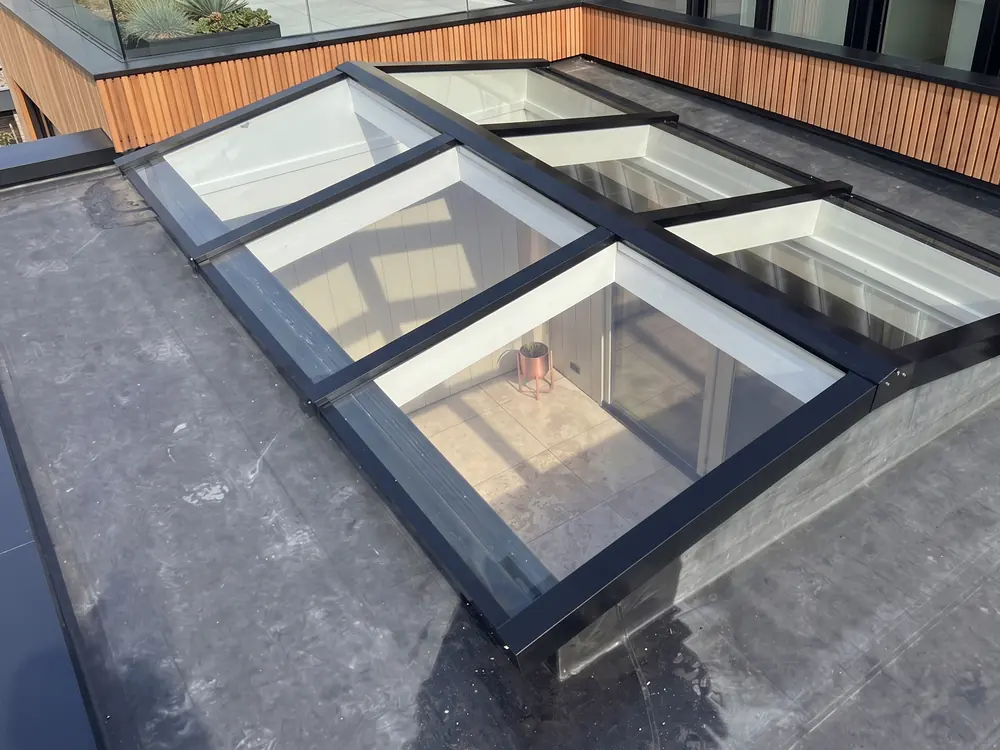
Solar panels on a flat roof are usually tilted in rows. A row directly south of the roof lantern casts shade on the glass, especially in winter when the sun is low. Conversely, a hipped or gable roof lantern with a high ridge can shade panels behind it. Keep a few metres clear on the sunny side; the installer can map the shading per season.
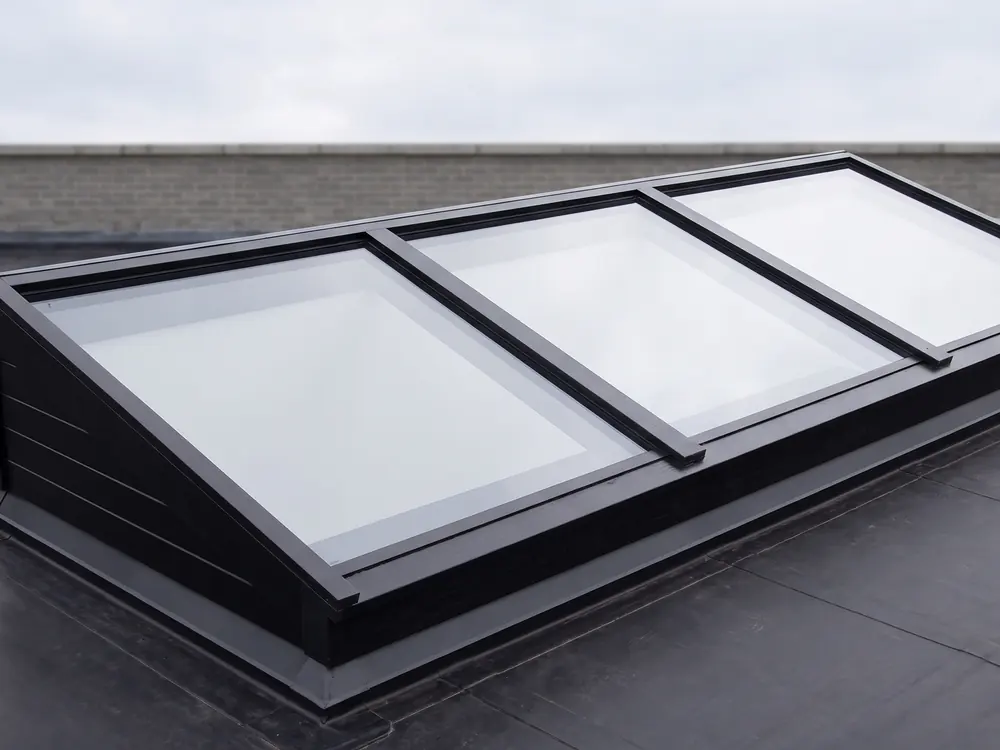
A mono-pitch roof lantern with its standard pitch of 8° stays low, casts the least shade and therefore fits most easily between panels.
Solar panels on a flat roof are often held down with ballast, such as tiles or concrete blocks against wind uplift. Together with the weight of the glass in a roof lantern, that adds up. An existing roof must be built for this. Have a contractor or structural engineer assess the load bearing capacity, as with any roof lantern in an existing flat roof.
Wind matters too. Around a raised roof lantern and rows of panels the wind flows differently. An installer takes the edge zones of the roof and any obstacles into account in the ballast plan.
A roof lantern brings in daylight during the day, so you switch lights on less often. Panels generate electricity. Together they make an extension both bright and economical. Do bear in mind that solar heat enters through the glass in summer. With a south facing roof lantern, shading is sensible, or the power from your panels ends up running the air conditioning.
No, never put panels on the glass. A roof lantern is not made for that load and you lose exactly the daylight you installed it for. Panels belong on the solid roof area next to it.
Preferably the roof lantern first, or both in one schedule. The roof lantern needs an upstand and a connection to the roofing. That work is harder once panels and ballast are already on the roof.
There is no fixed rule. Keep at least enough room to work safely around the roof lantern, and more on the south side so the panels do not shade the glass in winter. Your installer can draw this up for your situation.
Send a photo or sketch with dimensions. Within 24 hours you receive a quote with glazing options, lead time and price.
Request a quote Get in touchA few questions, a photo or the dimensions, and we will prepare a tailored quote. Prefer to call: +31 342 223 190.
Request a quote More information