
Home
For contractors
About us
Contact
Request a quote
Roof lanterns
Inspiration
Google-rating: 5.0★★★★★from 2 reviews
A roof lantern must carry the snow and wind loads set by the Eurocodes with the Dutch national annexes.
A free, no-obligation quote tailored to you in just a few clicks. You finish on the quote page, where everything is already filled in.
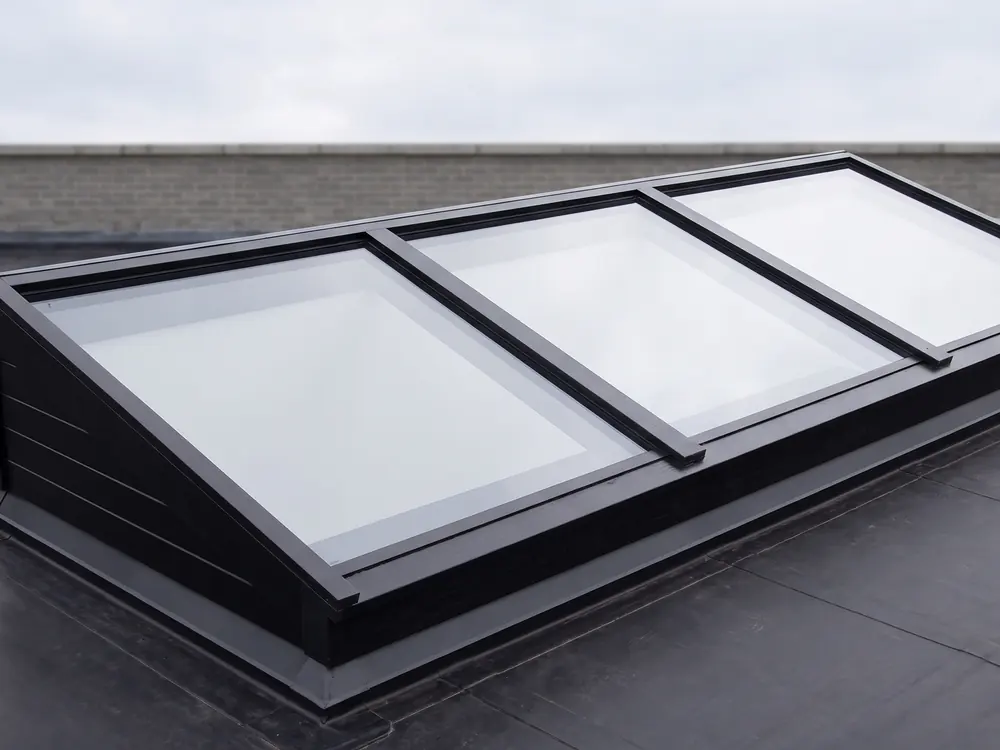
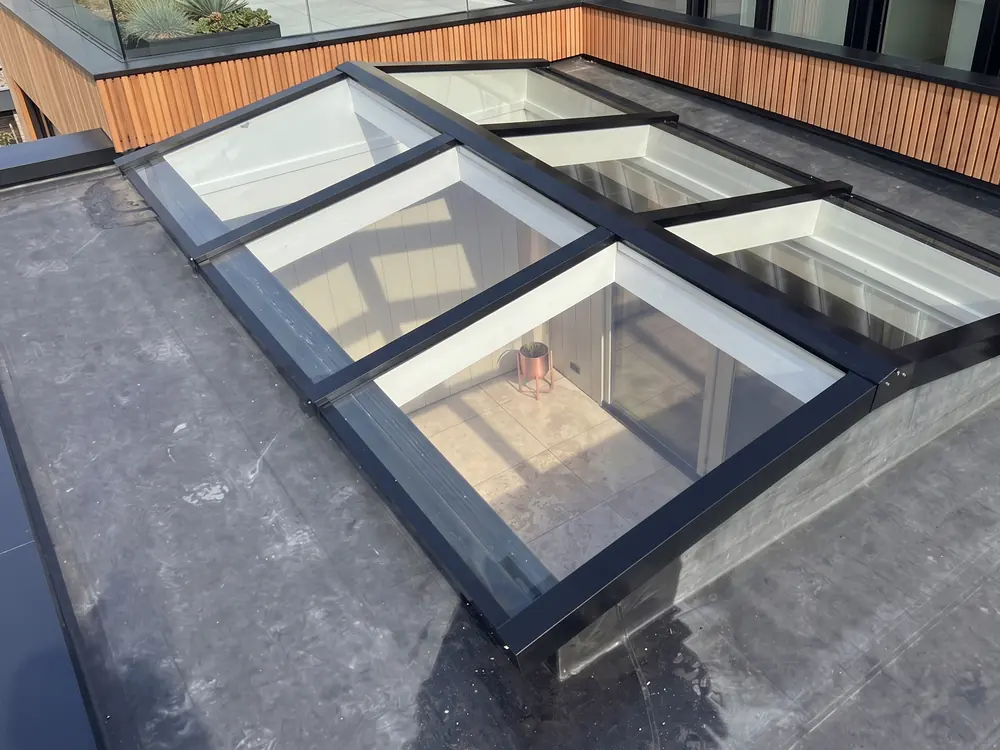 Lean-toGable
A roof lantern must carry the snow and wind loads set by the Eurocodes with the Dutch national annexes. For snow, the whole of the Netherlands uses 0.7 kN/m² on the ground, about 70 kilos per square metre; on a shallow pitched roof that comes to about 0.56 kN/m². Snow can drift against a higher wall, and wind counts more heavily on the coast.
For snow load and wind load on a roof lantern, the Eurocodes apply in the Netherlands. The snow load follows from NEN-EN 1991-1-3, the Eurocode for snow, with the Dutch national annex. It sets a characteristic ground snow load of 0.7 kN/m² for the whole country. On a roof, that value is multiplied by a shape coefficient that depends on the pitch. Up to a 30° pitch that coefficient is 0.8, which comes to about 0.56 kN/m², roughly 56 kilos per square metre.
For comparison: ten centimetres of fresh snow weighs roughly ten kilos per square metre, wet snow easily two to three times as much.
With a wall-abutting lean-to roof lantern or a lantern next to a higher section of roof, snow can build up. Wind blows snow against the higher wall and snow can slide off the higher roof. The Eurocode therefore applies a higher load in a strip along the wall at such a change in height. That is relevant for a roof lantern against a terraced house or on a roof extension.
A shallow pitch plays a part too. On a flat or gently sloping roof, snow stays longer. So the right pitch is not only good for drainage, it also helps shed snow.
Wind does not only press on a roof lantern, it also pulls at it. On the leeward side and at roof edges, suction occurs that lifts the glass and fixings. NEN-EN 1991-1-4 with the Dutch national annex divides the Netherlands into three wind zones: heaviest along the coast and on the Wadden Islands, lightest inland in the east and south. The height of the building and its surroundings count too; an open polder catches more wind than a housing estate.
At the roof edge, suction forces are higher than in the middle of the roof. Firm anchoring to the upstand is therefore essential.
A DagLichtDesign roof lantern is made to measure in the company's own factory in Barneveld. When requesting a quote, give the location and the situation, such as a coastal site or a high, open roof. The substructure, the upstand and the roof itself are for your contractor and, where needed, a structural engineer. They assess whether the roof can carry the extra load. A roof lantern is not walkable, so never clear snow by walking on the glass.
A roof lantern made to the standards and properly installed is designed for snow loads beyond a normal Dutch winter. The risk lies more in a weak substructure or exceptional drifting. In extreme snowfall, brush it off carefully from the edge.
Yes. Glass thickness and make-up should be matched to the loads, including wind. On the coast or on a high, exposed roof a heavier make-up may be needed. So include the location and situation in your quote request.
For the roof lantern itself, usually not. You may if you doubt whether the roof can carry the extra weight, for instance with an old roof or an existing flat roof. Your contractor will know when that is needed.
Send a photo or sketch with dimensions. Within 24 hours you receive a quote with glazing options, lead time and price.
Request a quote Get in touchA few questions, a photo or the dimensions, and we will prepare a tailored quote. Prefer to call: +31 342 223 190.
Request a quote More information