
Home
For contractors
About us
Contact
Request a quote
Roof lanterns
Inspiration
Google-rating: 5.0★★★★★from 2 reviews
Rainwater from a roof lantern runs over the glass and profiles onto the roof, and from there to the existing gutter or downpipe.
A free, no-obligation quote tailored to you in just a few clicks. You finish on the quote page, where everything is already filled in.
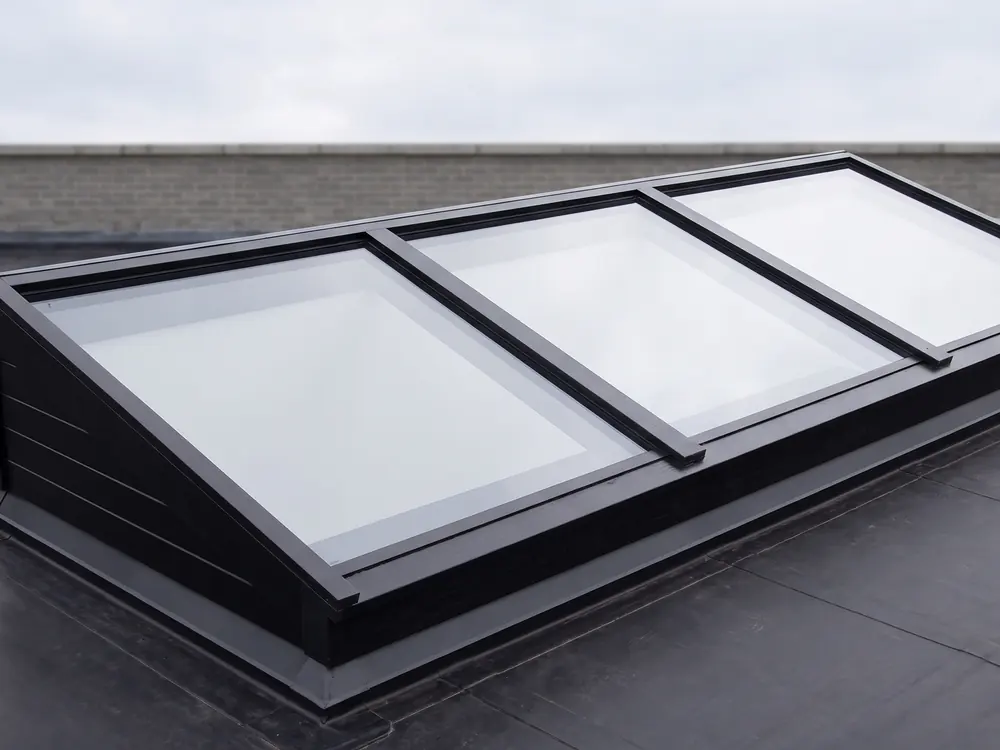
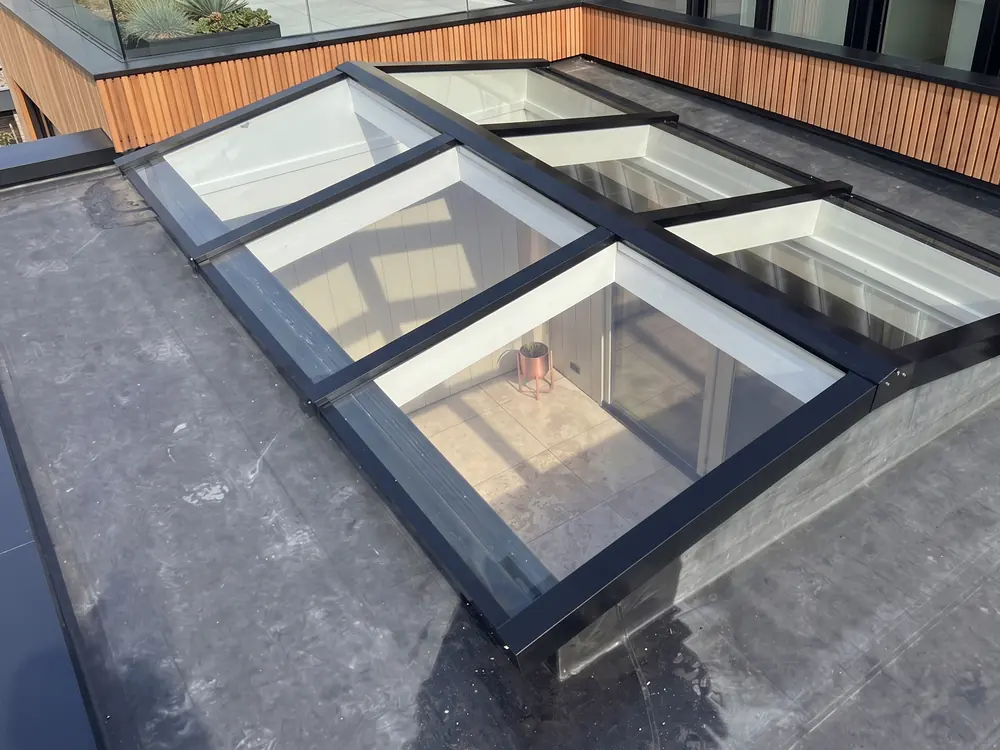 Lean-toGable
Rainwater from a roof lantern runs over the glass and profiles onto the roof, and from there to the existing gutter or downpipe. No separate drainage is needed. The pitch does have to be right, with a recommended minimum of 7 degrees for a mono-pitch roof lantern, and the roof around the upstand must drain well.
A roof lantern catches rain across its whole glass surface. That water runs to the lowest side, over the bottom rail or profile, and lands on the roof covering. The roof takes it on to the gutter, the outlet box or the downpipe that is already there.
Glass holds no water. In a heavy shower, water therefore comes down quickly and concentrated in one place. The fall of the roof must be designed for that: the water must be able to run away, not stand against the upstand.
With a mono-pitch roof lantern all water runs to one side. The standard pitch is 8 degrees, just above the recommended minimum of 7 degrees, so water and dirt run off well; read the right pitch for a roof lantern. A wall-abutting lean-to roof lantern connects to the wall at the high side with a wall connection profile and an EPDM lead substitute or zinc flashing.
A gable roof lantern has a self-cleaning drainage system in the bottom rails. With a hipped roof lantern the drainage is hidden in the bars and hip profiles.
Preferably don't place the roof lantern at the lowest point of a flat roof. Water collects there and stands against the upstand. The fall of the roof should run away from the upstand, towards the outlet.
Look at the drainage itself too. If water from a large roof lantern runs into a narrow gutter, check that it can cope. Leaves and dirt are the most common cause of overflowing. See maintenance and cleaning.
On a flat roof with EPDM or bitumen, the connection around the upstand also matters. The roof covering must be turned up well against the upstand, so splashing water and a brief puddle don't stand a chance. Read how this is done under connecting a roof lantern to EPDM.
No. The water runs to the existing gutter or downpipe. Only if that is already undersized, or if the roof lantern sends water to a spot without drainage, does the drainage need adjusting.
Often water is standing there that cannot get away: too little fall, a blocked outlet or a damaged connection. Read the possible causes under a roof lantern that leaks.
For good drainage the advice is at least 7 degrees. All four DagLichtDesign roof types have a standard pitch of 8 degrees, so you always meet that.
Send a photo or sketch with dimensions. Within 24 hours you receive a quote with glazing options, lead time and price.
Request a quote Get in touchA few questions, a photo or the dimensions, and we will prepare a tailored quote. Prefer to call: +31 342 223 190.
Request a quote More information