
Home
For contractors
About us
Contact
Request a quote
Roof lanterns
Inspiration
Google-rating: 5.0★★★★★from 2 reviews
With a roof lantern, the roof insulation must run without interruption right up to the frame.
A free, no-obligation quote tailored to you in just a few clicks. You finish on the quote page, where everything is already filled in.
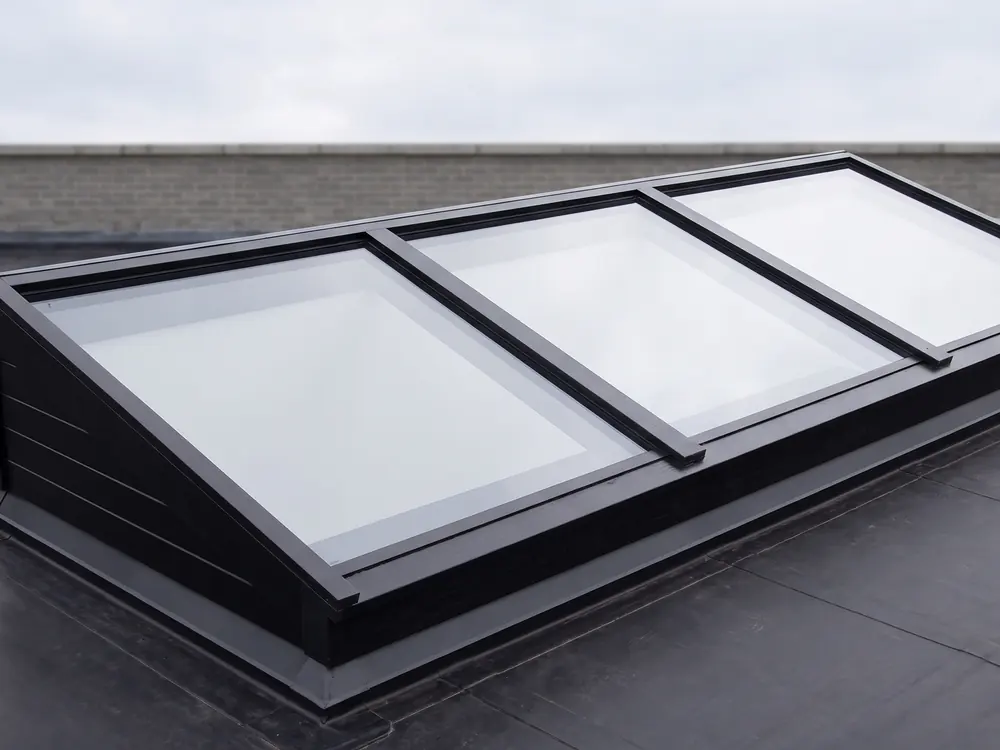
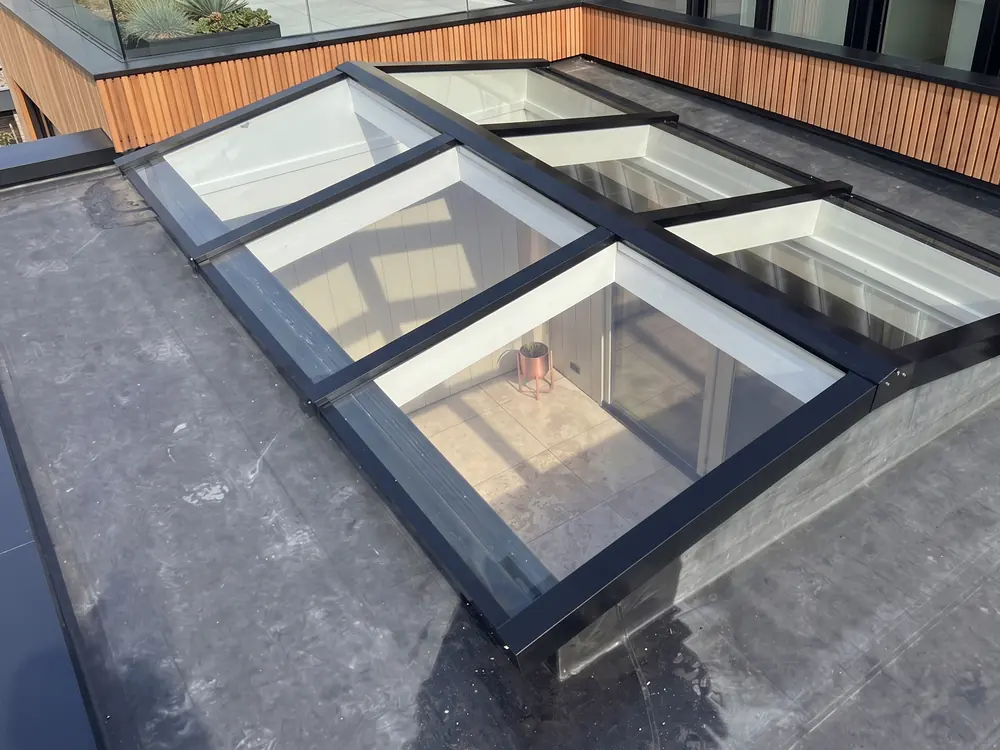 Lean-toGable
With a roof lantern, the roof insulation must run without interruption right up to the frame. The upstand is therefore insulated on the outside or inside, so there is no cold edge between roof and glass. A broken insulation layer creates a cold bridge, leading to heat loss and condensation.
A roof lantern makes a hole in an insulated roof. Around that hole is the upstand: a raised kerb on which the frame sits. If the roof insulation stops there and the upstand itself is not insulated, a cold strip forms. That strip feels cold and attracts moisture.
You usually only see the result in winter: damp patches on the interior finish, mould in the corners or drips along the edge. Many reports of condensation on a roof lantern have their cause here, not in the glass.
The roof insulation must continue against or over the upstand, up to the underside of the frame. The aluminium frame is thermally broken, so the cold outside is separated from the inside. That break only works if the upstand below it is insulated as well.
In the step-by-step section of our installation instructions, insulation is a fixed step between placing the upstand and sealing. More on height and build-up is under the upstand of a roof lantern.
The glass is the largest surface, but the edges are often the weak point. HR++ double glazing has a U-value of about 1.1 W/m²K. Triple glazing reaches about 0.5 W/m²K. For a well-insulated roof above a bedroom or facing north, triple can be worthwhile. Read the explanation of the U-value of glass.
If you are re-insulating the roof, for example during a renovation, that is a logical moment to include the roof lantern. The roof becomes thicker, and the upstand has to match it in height.
An old roof lantern with single or early double glazing is often the coldest spot in the room once the roof is newly insulated. In that case replacing the roof lantern in the same job can be sensible.
Often, yes. Thicker insulation raises the roof build-up, and the upstand must come well above the finished roof covering. Have the contractor determine the new height before you order a new roof lantern.
You can, but it is awkward. When insulating later, the connection around the upstand has to be redone. Ideally do roof and roof lantern in one go, certainly with a roof lantern in an existing flat roof.
No, glass insulates less than a well-insulated roof. With a good connection and the right glass choice, the loss stays limited. Read more about roof lanterns and heat loss.
Send a photo or sketch with dimensions. Within 24 hours you receive a quote with glazing options, lead time and price.
Request a quote Get in touchA few questions, a photo or the dimensions, and we will prepare a tailored quote. Prefer to call: +31 342 223 190.
Request a quote More information