
Home
For contractors
About us
Contact
Request a quote
Roof lanterns
Inspiration
Google-rating: 5.0★★★★★from 2 reviews
You lose more heat through a roof lantern than through the same area of insulated roof, but with modern glass the difference is manageable.
A free, no-obligation quote tailored to you in just a few clicks. You finish on the quote page, where everything is already filled in.
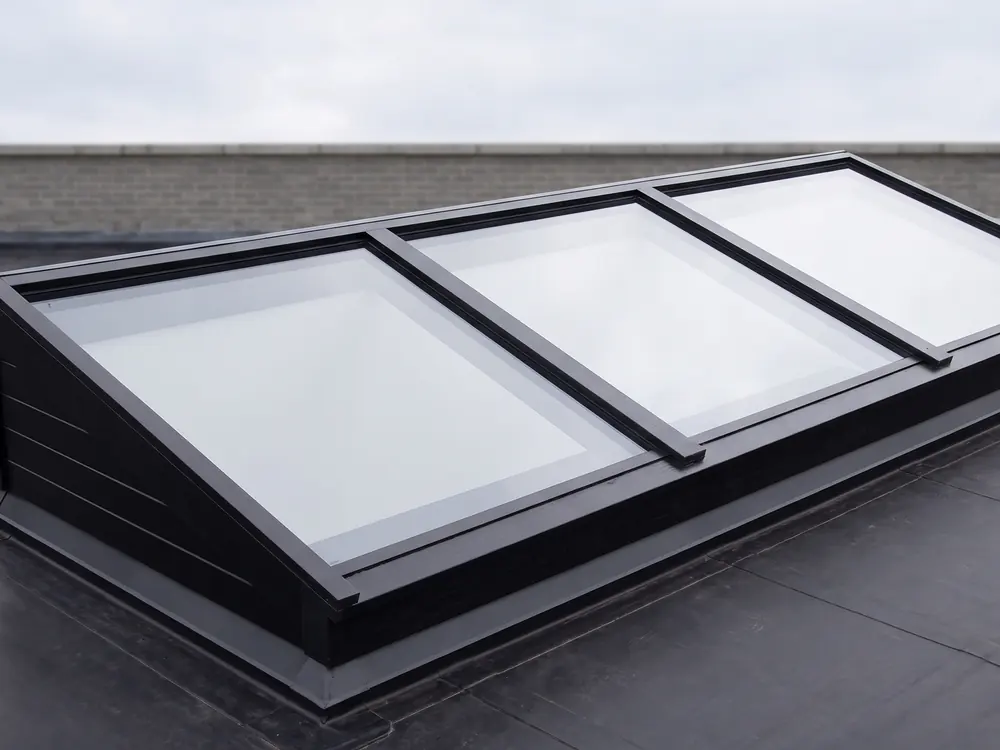
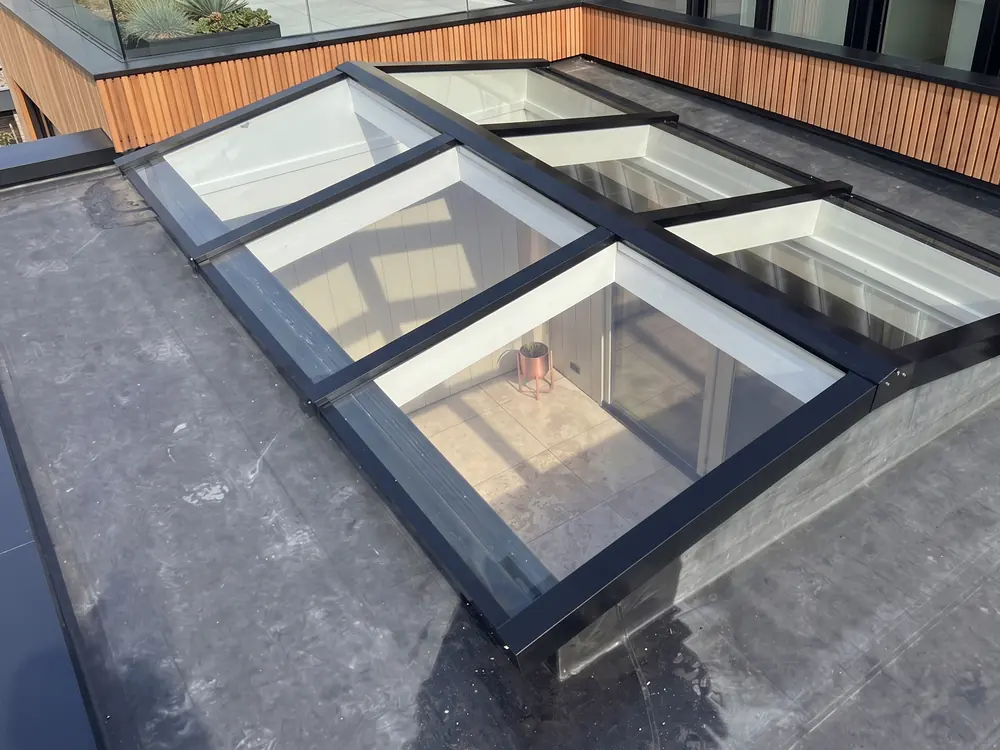 Lean-toGable
You lose more heat through a roof lantern than through the same area of insulated roof, but with modern glass the difference is manageable. HR++ double glazing has a U-value of about 1.1 W/m²K and triple glazing about 0.5 W/m²K. With 4 m² of glass and a 20 degree difference between inside and outside, that is roughly 88 against 40 watts.
Heat loss through a roof lantern depends on three things: the U-value of glass and frame, the area and the temperature difference between inside and outside. Multiply the three and you have the loss in watts. That is what the U-value means: the number of watts per square metre per degree of difference.
An example with 4 m² of glass and a 20 degree difference. HR++ with a U-value of about 1.1 gives 1.1 x 4 x 20 = 88 watts. Triple glazing at about 0.5 gives 0.5 x 4 x 20 = 40 watts. A well insulated flat roof of the same size loses about 12 watts. So the glass is the biggest item, but in absolute terms it is the output of a few old-fashioned light bulbs.
In older roof lanterns the biggest loss is often not in the glass but at the edges. An aluminium frame without a thermal break conducts cold from outside to inside. An uninsulated timber upstand or a gap between upstand and roof does the same. That is also where condensation forms first.
All DagLichtDesign frames are thermally broken. The upstand is your contractor's work; the installation guide supplied with every delivery includes a step by step plan for upstand, insulation and sealing. See also the upstand of a roof lantern.
Triple glazing roughly halves the loss through the glass. Whether it pays for itself depends on the size, the orientation and your energy price; within ten years that is not always the case. Triple mainly pays off above bedrooms and for a roof lantern facing north or west, where little solar heat comes in. For most living rooms and open kitchens, especially facing south, HR++ is more than enough. The full trade-off is in triple glazing or HR++.
Besides the energy bill, comfort counts. A warmer inner pane means less cold downdraught and less condensation. See also HR++ double glazing in a roof lantern and triple glazing in a roof lantern.
Yes. Sunlight falling through the glass warms the room. In spring and autumn, a south facing roof lantern can therefore give more heat than it loses on a sunny day. In summer that gain becomes a drawback; solar control glass or shading keeps the room cool. How this feeds into your label is explained in roof lantern and energy label.
The lower, the better. HR++ is around 1.1 W/m²K and is fine for most rooms. Triple glazing at around 0.5 W/m²K is the choice when insulation comes first. A detailed explanation is in the U-value of glass explained.
A pleated blind or screen closed in the evening adds an extra layer of air and reduces the loss a little. The real difference comes from the glass and a well insulated upstand.
With the same glass and area the difference is limited, but it is there. Glass lying flat or at a shallow pitch has a slightly higher U-value than the same glass fitted vertically, because the air in the cavity circulates more easily. Warm air also collects at the ceiling.
Send a photo or sketch with dimensions. Within 24 hours you receive a quote with glazing options, lead time and price.
Request a quote Get in touchA few questions, a photo or the dimensions, and we will prepare a tailored quote. Prefer to call: +31 342 223 190.
Request a quote More information